This page describes expected compatibility with other products that may enhance TrackAddict's capabilities further. Because most of these products are under the control of other entities, their interoperability with TrackAddict and the accuracy of this information is subject to change at any time without notice.
Windshield Mounts
Windshield mounts can offer optimal positioning for GPS reception, recording video, and displaying information to the driver.
Using a secure and sturdy mount is very important. A common problem is undesirable vibration or wobble appearing in the video and accelerometer G-force readings. Some phone models are more prone to video wobble than others, and this can vary between mount designs and placement / adjustment choices.
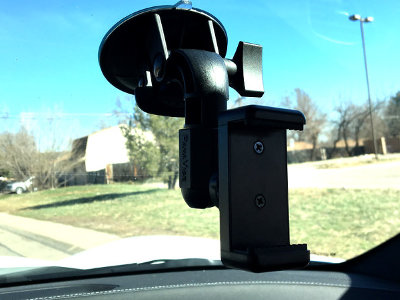
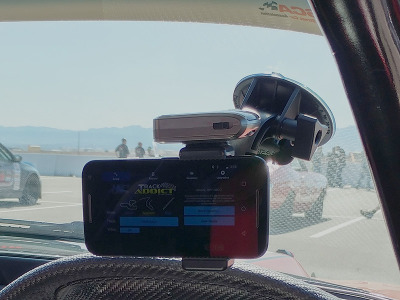
Of the mounts we've tested, the best results have been seen with the PanaVise Model 809 suction cup mount when combined with a simple Smartphone Tripod Attachment, attached via the mounting point in the center of its back side, as pictured below:
 |
 |
Other popular choices include the RAM Suction Cup X-Grip Mount (universal fit), Scosche MAGWSM2 MagicMOUNT Magnetic Dash/Window Mount, and similar products. These tend to work better than many cheaper or flimsier options, however some of these have been known to work great for some phones but then have fairly noticable wobble for others.
External / Enhanced GPS Receivers
Get the most out of TrackAddict with enhanced GPS data!
Your phone's internal GPS can be great to get you started with TrackAddict, but much better reception, accuracy / precision, and sampling rate are all possible with a GPS add-on device.
This can give you a significant improvement in reliability, timing accuracy, and data quality over the GPS hardware found within many phones and tablets. It can also be a big help in overcoming difficult GPS conditions with certain tracks or vehicles.
Compatible GPS Devices:
| GPS Product | Sample Rate | Connection | Compatibility & Notes |
|---|---|---|---|
| Dual XGPS160 Recommended choice for iOS |
10 Hz | Bluetooth | iOS & Android |
| Dual XGPS150 | 5 Hz* | Bluetooth | iOS & Android * Android is 1 Hz by default; 5 Hz mode can be enabled by connecting to it once with the iOS version of TrackAddict |
| Garmin GLO | iOS: 4 Hz Android: 10 Hz |
Bluetooth | iOS & Android On iOS, data is reported via the operating system's framework and typically comes in at around 4 Hz |
| Haze GPS_BT Recommended choice for Android External GPS antenna for maximum reception quality |
18 Hz | Bluetooth | Android Only |
| Qstarz BT-Q818XT Recommended choice for Android Self-contained GPS antenna for portability |
10 Hz | Bluetooth | Android Only |
| Qstarz BT-Q1000eX Older product; no longer sold |
10 Hz | Bluetooth | Android Only To enable altitude and accuracy information, use the MTKutility app to enable GGA messages on this GPS |
| Other Bluetooth GPS Units | 1 - 20 Hz | Bluetooth | Android Only Must provide standard NMEA-0183 text sentences (RMC, GGA, GLL) via Bluetooth Serial Port Profile (SPP) |
Classic Bluetooth GPS Device Setup (does not apply to Bluetooth 4/5 Low Energy, aka "BLE")
- iOS: Pair the GPS with your iOS device using Bluetooth, then set TrackAddict's GPS option to "XGPS150/160" mode. Please note that Bluetooth devices are heavily restricted by Apple, and only the specific devices indicated in this chart for iOS will work.
- Android: Pair the GPS with your Android device using Bluetooth, set TrackAddict's GPS option to "Bluetooth", and then select your GPS device.
Except for the devices noted above which may utilize a direct connection, TrackAddict will receive GPS location data via operating system's standard location service. TrackAddict will attempt to handle any sample rate provided to it, up to a maximum of 20 Hz. The devices, operating system, and other factors can limit the data rate and quality that's actually available to this app.
OBD-II & CAN Vehicle Interfaces
Log and display vehicle data like Engine RPM, Throttle Position, Coolant and Intake Temperatures, Fuel Trims, and more! TrackAddict is also able to scan and reset powertrain Diagnostic Trouble Codes (DTC's).
You'll need an OBD-II compliant vehicle and a compatible interface device for TrackAddict. Available data channels, features, and performance will vary depending on what your specific vehicle supports, and also based on your OBD-II interface device's capabilities. Some vehicles will work better than others. Except for special cases, this is generally limited to data that's available via the standardized SAE / Mode 01 parameter set.
Gear number estimation will be available on the lap detail and video screens if you log both Vehicle Speed and Engine Speed (RPM). This is based on data observation, and may not detect 1st gear in some situations, so there is a "Gear +1" option available to correct this on the video display.
Boost, for turbo and supercharged vehicles, is available to graph on the lap detail screen if you log both Intake Manifold Pressure and Barometric Pressure. Some phones also include their own barometric pressure sensor, which will provide data that can be used if the vehicle does not report it via OBD-II.
Compatible OBD-II Interface Devices:
| OBD Product | Connection | Compatibility & Notes |
|---|---|---|
| HP Tuners MPVI3 / RTD Gen 3 Recommended choice for tuning and maximum data acquisition Also supports engine & transmission tuning and data on Windows computers See HP Tuners website for more info and supported vehicles MPVI3 / RTD requires TrackAddict v4.7.1 or newer |
Bluetooth | Android & iOS; Enhanced Support Supports CAN, VPW, PWM protocols ISO-9141 and KWP protocols (some pre-2008 vehicles) may have limited compatibility |
| HP Tuners MPVI2+ / RTD+ | Bluetooth | Android & iOS; Enhanced Support Supports CAN, VPW, PWM protocols ISO-9141 and KWP protocols (some pre-2008 vehicles) may have limited compatibility |
| HP Tuners MPVI2 / RTD | Bluetooth | Android Only; Enhanced Support Supports CAN, VPW, PWM protocols ISO-9141 and KWP protocols (some pre-2008 vehicles) may have limited compatibility |
| Carista | Bluetooth (Android) BLE (iOS) |
Android & iOS |
| GoPoint BT1A Older product; no longer sold |
Bluetooth | iOS Only |
| Hondata s300 v3 Hardware module for OBD-1 Hondas |
Bluetooth (Android) BLE (iOS) |
Android & iOS Bluetooth name must be set to "s300" |
| OBDLink CX BLE | BLE | Android & iOS You must first use OBDLink app to pair it to your device Set the OBD option to "BLE". Requires TrackAddict v4.7.0 or newer. |
| OBDLink LX Bluetooth Recommended choice for Android |
Bluetooth | Android Only |
| OBDLink MX / MX+ Bluetooth | Bluetooth | Android Only Please note that this app does not support the MX+ on iOS |
| OBDLink MX WiFi Older product; no longer sold |
WiFi | Android & iOS |
| OBDLink SX USB | USB Cable via USB OTG adapter |
Android Only Requires an Android 6.0 (Marshmallow) or newer device with USB OTG |
| PLX Kiwi 1 / 2 / 2+ Bluetooth | Bluetooth | Android Only |
| PLX Kiwi 1 / 2 WiFi Older product; no longer sold |
WiFi (Adhoc) | iOS Only |
| PLX Kiwi 3 Recommended choice for iOS |
BLE | Android & iOS Please note that the Kiwi 4 is not compatible with this app |
| Veepeak OBDCheck BLE | Bluetooth (Android) BLE (iOS) |
Android & iOS |
| Other 100% ELM327 Compatible or STN11xx Devices Supported as-is. Beware of cheap knock-offs! |
WiFi / Bluetooth / USB |
WiFi Devices: Android & iOS If OBD device doesn't use a common IP & port, you will need to enter it manually Classic Bluetooth Devices: Android Only This does not include Bluetooth Low Energy (BLE) USB Devices: Android Only You may need to select the baud rate; OBD device must use 8 data bits, no parity, 1 stop bit USB mode requires an Android 6.0 (Marshmallow) or newer device with USB OTG |
BLE is "Bluetooth Low Energy", also known as Bluetooth 4 and 5, which differs from classic Bluetooth devices. Although BLE may have limited performance, it is a useful way for hardware manufacturers to work around Apple's Bluetooth restrictions on iOS. Please note that only specific BLE devices are supported, as this is not universal like classic Bluetooth can be.
iOS Users:
- The BLE options listed in this chart are usually the easiest to setup and use. In many cases, you shouldn't need to pair it to your iOS device, just simply set TrackAddict's OBD setting to "BLE".
- Classic Bluetooth devices are heavily restricted by Apple. Only the specific Bluetooth devices indicated in this chart for iOS will work.
Android Users:
- Classic Bluetooth devices are the norm for this platform. Pair the OBD interface with your Android device using Bluetooth, set TrackAddict's OBD option to "Bluetooth", and then select your OBD device.
- HP Tuners MPVI2 Guided Setup: Tap the Options icon near the top left of the main Setup screen, and then select "Setup HP Tuners MPVI2".
- If using a USB device, you will need USB OTG (aka USB Host Mode) support and may need a USB OTG adapter cable. This works better on some devices than others.
Once you have enabled OBD functionality from the Options screen, it may take a minute or two for the app to find your OBD-II interface and establish a connection, especially for the first time. Ensure that your vehicle's engine is running, and that a compatible interface device is plugged into your OBD-II port.
If using a WiFi-based OBD interface, you'll need to make sure that your iOS or Android device is connected to its WiFi network. This can prevent the External Camera Control feature from working, because you can only be connected to one WiFi network at a time.
Make sure that other apps are not using the OBD device, otherwise we may not be able to connect to it. Some apps may have a connection to it in the background, so make sure they are not running. Android users should also ensure that such apps are not running as a service, as may be indicated by the top status bar.
Users of the "Torque" app: Torque has been known to hold a connection to the OBD device in the background, which makes it unavailable to TrackAddict and others. To shut that down, launch the Torque app, tap its gear icon at the bottom left, and select "Quit". TrackAddict should then be able to connect to the OBD device. You may need to repeat those steps after any time you use the Torque app, or if you restart your Android device.
CAUTION: Not all devices that claim to be ELM327 are authentic or sufficiently compatible. The market has been flooded with many inexpensive knockoffs / clones, often heavily advertising themselves as simply "ELM327", and under no other brand name or a Chinese brand. Although these devices often function at some level, the sample rate tends to be low, and the quality and compatibilty have been very inconsistent and problematic. What works with one unit / vehicle / app may not work with some others. These cheap clones have been a huge source of reported OBD problems and are strongly not recommended! We warned you... Please don't complain when these devices don't work properly for you, or if they stop working.
Numeric Broadcast Protocol (NBP) Devices
Add even more data channels, and use your own custom devices!
TrackAddict can receive additional data channels from compatible devices that broadcast data via Numeric Broadcast Protocol (NBP). This is a simple universal format for devices to easily broadcast data to apps.
See also: NBP Developer Information.
| Connection | Compatibility & Notes |
|---|---|
| Classic Bluetooth Serial Port Profile (SPP) |
Android Only |
| WiFi User must enter the device's IP address and port number |
iOS & Android |
| USB Cable via USB OTG adapter |
Android Only Experimental / As-Is Requires an Android 6.0 (Marshmallow) or newer device with USB OTG |
External Camera Control (GoPro, 360fly, Garmin, etc.)
IMPORTANT: Due to platform restrictions that can limit the ability of apps to automatically scan, connect, or use WiFi connections, this feature has unfortunately become less reliable on newer devices. Furthermore, newer cameras may also use different connection protocols that aren't known to us. However, we have found that the voice control feature of newer GoPro cameras is a great alternative to this, as shouting "GoPro, Start Recording!" tends to work very well, even with a helmet on.
TrackAddict can automatically attempt to start and stop an external video camera at the same time as your session recordings. This is essentially a remote-control feature, which can be enabled from the Options screen.
The camera must be powered on, its WiFi or app-control option must be enabled, and your device must be connected to its WiFi network.
Please note that your iOS or Android device can only be connected to one WiFi network at a time, so this limits you to controlling just one camera at a time, and would also prevent the use of WiFi-based OBD-II interfaces. On some devices, this may also prevent Internet data access, which is needed for the Live Telemetry Streaming feature.
These video recordings will remain on your camera, and are separate from the app's built-in video capabilities. The external camera's footage will not consume the limited space of your smartphone or tablet, but it also will not be available for playback or rendering from within this app. You can use TrackAddict's built-in video capability to record another angle at the same time from your device's internal camera. That footage is what would be available within the app after you finish recording your session.
Our RaceRender software can be used to create a video that utilizes the external camera's footage, while overlaying the telemetry data (and additional video, if applicable) that was recorded by TrackAddict. Open your session and tap on the "Share" button to see options for sending your data/video from TrackAddict to RaceRender over WiFi or USB.
Cameras That TrackAddict Can Control:
| Camera | Connection | Notes |
|---|---|---|
| 360fly 4K | WiFi | |
| 360fly HD | WiFi | |
| GoPro HERO 4 / 5 / 6 | WiFi | Older HERO 4 models may need a firmware update. Unfortunately, this feature has not been known to work reliably with GoPro 7 and newer models at this time. |
| GoPro Session | WiFi | Expected to work, but not tested. Support is provided as-is. |
| GoPro HERO+ LCD | WiFi | |
| GoPro HERO 3 / 3+ | WiFi | |
| GoPro HERO 2 w/ WiFi BacPac | WiFi | Expected to work, but not tested. Support is provided as-is. |
| Garmin VIRB Elite | WiFi | Other Garmin VIRB models that support WiFi control might work, but are not tested. |
| SJCAM SJ4000/SJ5000 (WiFi models) Authentic cameras only; beware of clones and knock-offs Does not support SJ4000 Air 4K or similar models |
WiFi | This support is experimental, and is subject to change or removal, pending testing and user feedback. Other SJCAM models that support WiFi control might also work, but are not tested. |
External Camera Control is not a universal technology. We have to invest development resources and write new code for each specific camera brand or model. As such, we are only able to support certain cameras.
Data Visualization and Video Overlay Software
Video + Data Overlay
TrackAddict offers video + data overlay playback right on your device. Just open a session where you recorded video and tap on the "Video" button.
For iOS devices, it's also possible to export these to your photo album, which can then be e-mailed, uploaded, or shared elsewhere. For sharing videos with data overlays from Android devices, please try our RaceRender software.
Our RaceRender software offers full-featured data overlay capabilities and customizations for data and video recorded by TrackAddict, and for many other data and video devices. Open your session and tap on the "Share" button to see options for sending your data/video from TrackAddict to RaceRender over WiFi or USB.
Data Analysis
TrackAddict offers the ability to export your data into a variety of formats. Open your session and tap on the "Share" button to access these options:
- "Interpolated CSV" is most useful for viewing your data in spreadsheet software.
- "GPS eXchange / .GPX" is often suitable for use with GPS viewers and mapping tools.
- "Google Earth / .KML" is of course meant for Google Earth.
- ".VBO" is a CSV-like format that's commonly used by motorsports data analysis tools.